The Great Escape is almost half over! We have made it through Lithuania and the Cotswolds in rural England; still ahead, a week in London, to which we’ve just arrived, and then the coast of Spain. Hopefully there at last we’ll get more than 24 hours between rainstorms.
View from the Woolpack pub in Slad Valley
After a drive that took us through Oxford, at which I panted out the window of the car like a forlorn hound, we’ve made it to our AirBnB rental in town. It turns out to be a boarding house we’re sharing with our host, her daughter, a fellow from Barcelona, a couple from Italy, a black-and-white cat, and possibly David Copperfield. Not 100% what we expected but no matter.
Quite close is a neighborhood called Shepherd’s Bush, and I will try manfully not to snigger every time I walk by. Considering we passed Maidenhead on the way in, I’m assuming the British have excellent restraint, or perhaps are merely used to giggle-inducing names. Can you imagine a suburb of DC called Virginity? I mean, really.
Although of course there is “Virginia” …
Anyway. London! At last! England is my Oz, which makes London my Emerald City. I almost cannot contain my excitement at finally getting to explore this place I’ve read so much about, except that I must, because I’ll be on baby duty all week and will only be able to accomplish so much. Life is long and will bring me back to London, right? There’s no need to maximize.
The “Great Escape” Mr. Ben and I originally considered involved going away for six months or a year. We figured that while babygirl was between nine months and two years old, she would be portable — or, at least, as portable as she would ever be outside the womb. (Taking her anywhere, even as a small ten-month-old with few material possessions, is still reminiscent of the scene in the desert in Spaceballs, when the crew has to shlep all of the Princess’s matched luggage. It’s enough to make me nostalgic for the relative ease of pregnancy.)
Well, we had to scale back the dream a bit, for various very sensible reasons. But the dream lives. For an entire year, I will focus on writing: the manuscript of the novel I’m currently working on, a revision of the novel I wrote when I first came to New York, perhaps more short pieces for the Internet, since the thrill of contributing to Slate and the Hairpin and those kinds of places has yet to wear off. To start the year off with a bang, I signed up for the Summer Literary Seminars program in Vilnius, Lithuania, to study fiction with Jami Attenberg in the mornings and non-fiction with Alex Halberstadt in the afternoons. Since both of these writers are Jews living in Brooklyn, it feels appropriately inefficient and complex — you know, Soviet! — to come halfway around the globe to an Eastern European capital from which my ancestors fled in droves to take workshops with them.
Best of all, Mr. Ben knit together seven weeks of leave from his job of vacation time and FMLA leave so that he could come too and bring babygirl. (By contrast, I parted ways with my job, where I spent four interesting and meaningful years and still have coworkers I care about.) After my two weeks at SLS, we go to Britain in order to fulfill a dream of Mr. Ben’s (about which more later), and then the coast of Spain, where family friends have an empty house that they have offered up. Old-world capital, English countryside, Mediterranean coast: this is “Eat, Pray, Love” done the Balynker-Gloom way. As my Aunt Marjy put it, Lara’s “How I Spent My Summer Vacation” essay is going to be the best ever!
Basking in the Eastern European sun
Our passports got stamped in Copenhagen, where we spent an endless layover thinking wistfully about the sophisticated Scandinavians — so clean and organized, and yet so child-friendly! — and whether we were crazy to take an infant to the Baltic. Then a plane as long as two minivans lashed together whisked us away from Danish paradise and dropped us off on a rainy Lithuanian tarmac. The weather only got soggier as we made our way to the apartment we secured on AirBnB, and babygirl only got more upset as we set up her travel crib and put her in it for the first time. (Eighteen hours on the road and all I get is this big mesh box?) There were bright spots even then, though, specifically the apartment, which reflects the taste of its owner, a talented graphic designer. It’s hard to be unhappy in a place with a bright yellow vintage fridge.
The next day the sun came out, as cheerful as a bright yellow vintage fridge, and we ventured forth into a walkable and surprisingly lovely, low-key city that didn’t feel too different, after all, from Copenhagen. We’ve met a couple of motorcycle-riding Lithuanians who have a daughter Lara’s age, and a plethora of poets (“Which MFA program are you in?”) with inner-arm tattoos, which seems to be the thing these days, like side shaves. We’ve overheard some live foreign-language Christian rock (“Yesu, Yesu …”) and lots of recorded hip hop, which is a bit jarring in a country full of pale blond people, and eaten lots of dill and some ham already by mistake and really good Latvian yogurt.
Even my ancestors would, I think, appreciate this town. I can hear them crowded around me as Lara plays in the sandbox at the heart of what was once the sprawling Jewish ghetto: “Hmph. Not too bad, when the clouds disperse. It has potential.” And then, inevitably, “Her hat! Make sure she keeps her hat on!”
Not my best year for reading. What with the craziness of gestating, birthing, and then caring for an infant, I did lots of re-reading for comfort instead of seeking out the new and exciting. Still, any year in which I made it through both Moby Dick and David Copperfield is not worth erasing from the historical record entirely.
Bringing Up Bebe (Druckerman) – B-
French moms don’t get frazzled. They manage stay sane and calm, thanks in large part to fantastic Nanny State programs and benefits that makes childbearing and child-rearing as easy as possible, and also to cultural differences that don’t turn women into “mommies” — child-obsessed, compulsive, as well as chubby, shlubby, and self-denying — the way American society does. Unfortunately the narrator is the kind of woman who compares herself to Carrie Bradshaw, which makes her hard to take seriously, and she paints a kind of ridiculous Goofus and Gallant contrast between the countries.
Telegraph Avenue (Chabon) – B-
Come on, dude! Stop overwriting, over-plotting, and over-filling your narratives with characters. You’re not penning a 19th-century Russian epic. If TA weren’t by Mr. Kavalier & Clay, I’d have put the book down before now, but I’m holding out hope it gets better as MC hits his stride and stops trying so hard.
Also finished (or abandoned) before the year’s end:
Divergent (Roth) – B- Pretty good trash, as trash goes. Entertaining. Definitely not a contender for next Hunger Games.
Insurgent (Roth) – C+ Sloppy and haphazard. Still reasonably entertaining. Strong female protagonists always earn some leeway from me.
The Bad Girl (Llosa) – B. Unfinished. Well-written and interesting, but the narrative loses steam and starts meandering halfway through.
The End of Men (Rosin) – C+ Some good thinking; lots of bad editing; and a terrible title that eclipses her more measured arguments. The thesis that seems to hold for some chapters has no relevance to other chapters, some of which are downright contradictory. Altogether a frustrating read. (Though funny to hold on the subway when 9 months pregnant.)
The Middlesteins (Attenberg) – B Starts strong, becomes conventional, ends up in a way I doubt I’ll recall in a month. Would have made one killer short story.
Here’s the rest of the round-up in alphabetical order, featuring a couple of classics, lots of memoir, Cramming for Motherhood manuals, history delivered in exciting & memorable ways (Bringing Up the Bodies, 11/22/63, Hark! A Vagrant), some solid genre fiction (Devil in a Blue Dress, Maltese Falcon, The Spy Who Came In From the Cold, The Comedians), some disappointing literary fiction (1Q84, The Marriage Plot, Sense of an Ending, Open City) and the unforgettably bizarre 50 Shades of Grey, without which I would never have been invited to appear on Geraldo.
Best surprise: Suite Francaise, which I didn’t expect to like, let alone be ravished by.
Best non-surprise: Tiny Beautiful Things, which was exactly as moving and profound, witty and wry as I expected. A more rewarding experience than Wild, leading me to the odd conclusion that I may prefer Strayed-as-Sugar to Strayed-as-Strayed.
NOTE: I’m still fiddling with the grades, since when I’ve just finished a book, I’m usually too kind to it, being either relieved to be done or still basking in its glow. Only in retrospect can I more accurately judge whether the reading experience holds up.
11/22/63 (King) – B+/A-
Arcadia (Groff) – B
Are You My Mother? (Bechdel) – B+/A-
Baby Catcher (Vincent) – B+
Bring Up the Bodies (Mantel) – A
Changing My Mind (Smith) — didn’t get to finish but really liked
Cocktail Hour Under the Tree of Forgetfulness (Fuller) – B
David Copperfield (Dickens) – B+/A-
Devil in a Blue Dress (Mosley) – B+
Fierce Attachments (Gornick) – A
Fifty Shades of Grey (James) – C-
Gone Girl (Flynn) – B
Half-Broke Horses (Walls) – B/B+
Hark! a Vagrant (Beaton) – B+
Ina May Gaskin’s Guide to Childbirth (Gaskin) – B+
IQ84 (Murakami) – C
Is Everyone Hanging Out Without Me? (Kaling) – B
Mildred Pierce (Cain) – B
Moby Dick (Melville) – B
Moonwalking with Einstein (Foer) – B
Open City (Cole) – B
Sempre Susan (Nunez) – B
Suite Francaise (Nemirovsky) – A-
The Art of Fielding (Harbach) – A-
The Comedians (Greene) – B
The Happiest Baby on the Block (Karp) – B+/A-
The Maltese Falcon (Hammet) – B/B+
The Marriage Plot (Eugenides) – B-
The Psychopath Test (Ronson) – B/B+
The Robber Bridegroom (Welty) – B
The Sense of an Ending (Barnes) – B
The Spy Who Came In From the Cold (Le Carre) – B
Tiny Beautiful Things (Sugar) – A
Why Be Happy When You Could Be Normal? (Winterson) – A-
Wild: From Lost to Found on the PCT (Strayed) – B/B+
I didn’t have Christmas growing up, so I never got what was funny about leg lamps. I never sang “Jingle Bells” unironically or even saw It’s a Wonderful Life. Over the years, mostly from pop culture parodies, I’ve picked up the salient bits: small-town family, bad bankers, wise angels, rash decision reversed, and voila! Happily ever after. That understanding in no way prepared me for my first real Christmas, which I celebrated with my Russian-Jewish father-in-law, his Italian-American wife, her brother the priest, and the priest’s surprise.
As a child, I was an outsider when the whole country went Christmas crazy. I had only Hannukah, which is like a kid playing a kazoo on the sidelines while a marching band in full regalia, with cheerleaders and baton twirlers and gymnasts and everything, spends a month slowly parading by. Then, I got older, and the meaning of Christmas evolved—it became the time I got laid off. Twice, including once during the Great New York Transit Strike of 2005. Even for someone who doesn’t celebrate the baby Jesus, that’s pretty harsh.
My first real Christmas on the inside made all the difference. Suddenly I understood. We go nuts for four to six weeks in advance of this holiday because it’s terrifying. 24 hours with our families where we’re expected to be kinder, gentler, more charitable versions of our screwed up selves? Where we have to open boxes of things we never wanted in front of everyone and pretend to be excited, while nervously watching everyone else open the presents we got them to see if they’re sufficiently appreciative? Where we have several meals with extended family members and in-laws, who take a long looks at us and comment on whether we’re more or less skinny than before? Those stakes are high.
Mr. Ben, my husband, is also Jewish, but unlike me, he grew up with mistletoe and ornaments. His father brought the tradition over from Russia when he emigrated; there, under Communism, it was a Secular Mandatory Fun Day, with the part of Big Brother played by the ominous-sounding Father Snow. (Particularly ominous if you’ve read Game of Thrones.)
Once we were living together and engaged, Mr. Ben asked me to come to Christmas. For reasons of principle, I was hard to convince, but finally, like anyone who’s ever been in a lasting relationship, I caved. Mr. Ben’s dad’s second wife, Carla, was Italian and an excellent cook; she also had a reputation for giving such good presents that all the Hunger Games-level agony of Christmas shopping became retroactively worth it. Between a bounty of material goods and Martha Stewart-type treats, I figured the holiday would be painless, maybe even kind of fun.
Carla had invited her brother Ned, a 50-year-old Catholic priest, as well as their aged old-world Italian mother. Shortly before he arrived, Ned told Carla that he would be accompanied by his friend, Winston.
Ned went to seminary at 18. He had never so much had dated a girl; from childhood, his vocation was clear. That is partly why Ned’s mother, always so proud of her son the priest, looked confused to be introduced to Winston, a very nice middle-aged Asian-American man. Mr. Ben’s Russian grandmother sat next to her on the couch across from the fireplace, perhaps thinking that the fact that her own son had re-married a shiksa now seemed not so bad. Winston and Ned, oblivious, glowed happily next to each other on the piano bench.
Still: Christmas! A brightly-lit, colorfully-decorated tree presided over an avalanche of boxes and bags. Delicious smells wafted from the kitchen, where Carla, tongue-tied with awkwardness, had escaped to tend to the meal.
“Let’s play a duet!” Ned suggested.
“Great!” replied Winston.
Being that this was my first real Christmas, I had no idea whether any of this was normal. Maybe Catholic priests always used Christmas with their Russian-Jewish extended families to come out to their horrified, blindsided mothers, one piano duet at a time. Or maybe Winston was really just a friend and we were all over-reacting.
As we began to exchange presents en masse, that hope faded. “For you!” said Ned.
“Thank you!” cried Winston, opening a box of two button-down shirts: one bright purple, the other bright pink. “And that one’s for you.”
Ned picked up the flat package and ripped it open. “Oh my gosh!” he said. “You didn’t!”
Ned showed us the present he had just received, and I choked on my Diet Coke. It was a framed, signed poster of “Will and Grace.”
The only gayer present? Probably a butt plug. Probably.
The next morning, Ned’s mother and Carla appeared dressed and ready for church. Ned and Winston came out of the guest room dressed and ready to go antiquing. It was at this point that Ned’s mother’s heart fell to the hardwood floor like a big red shiny ornament and smashed into a million pieces. We could all hear it except for Ned, who, with Winston, went on his merry way. And at last, Christmas was over.
Ned and Winston now live together in a wonderful old house in Amish country with two pianos and lots of knickknacks. Ned is no longer a priest. I don’t know if he ever officially came out to the family or whether he figures that, after the “Will and Grace” poster, it would be redundant, but he has reconciled with his mother, who is very fond of Winston. And I have learned that while Thanksgiving may be a big deal for drama, Christmas totally takes the (fruit)cake.
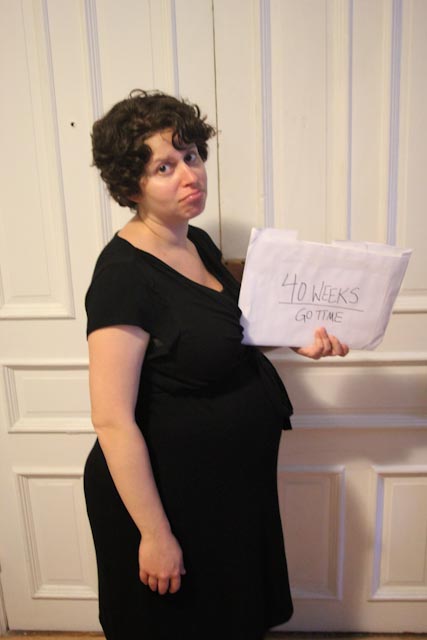
40 Weeks. Ready to pop, with an emphasis on ready.
Labor progressed early, as I mentioned, leading me to the hospital within hours; then a mean midwife threw me into reverse and sent me home. An hour later, though, I was back to where I started, contracting regularly, and in increasing, sledge-hammer quality pain from what turned out to be back labor. But we couldn’t go to the hospital or we’d be back once more under the jurisdiction of the mean midwife. We decided to tough it out at home.
From about 12:30 AM until 6:30, we used the tools at our disposal: a yoga mat, water, highly-diluted Vitamin Water, bendy straws, massage, frozen vegetables, mantras, more water, and a rubber ducky from the O’Haire Motor Inn in Montana. There was also quite a bit of cursing and crying. Every few minutes, I looked at Mr. Ben and said either: “It huuuuuurts” or “I can’t do it. I’m sorry, honey, I can’t.” And he would say, “You are doing it. You’re doing great,” and empty the freezer of more bagged produce to push against my back.
“Breathe, honey,” he told me. “Don’t forget to breathe. Keep breathing.”
We ruined the frozen corn, the raspberries, the edamame, turned them all to slime. I didn’t notice. I sprawled on the bathroom floor in various positions, clutching my husband’s hand, listening to him tell me it would be okay. I spent about an hour in the shower and then another hour in the bath with him pouring water on me, singing to me, doing anything he could to distract me from my certainty that I couldn’t do it, that I couldn’t push to the other side of the smashing, obliterating pain.
BEN NOTE: The pain had a predictable peak, it would be painful and seem endurable, and then would ebb, and then would come back much much stronger and you would cry out and you would have to breathe in and out about four times until it was finally over. I was aware of every contraction because I was trying to time them on the app I had downloaded to my iPod touch, at least at first. I stopped for a while when I realized that we were in it for the long haul and the contractions were not really changing in length or frequency much.
(Hereafter Mr. Ben’s comments are in blue bracketed italics within the text.)
I shivered, and then I sweated, and then I shivered again. [We got to know our bathroom floor better than any other bathroom floor before or since.] I drank what felt like gallons of water [in fact you took on the tiniest sips that I had to force on you] until the very sight of a bendy straw made me nauseous. When I could catch my breath between contractions, I repeated a phrase from a prayer my shul’s congregation recites every Shabbes: “We have not come into being to hate or to destroy; we have come into being to praise, to labor, and to love.” Possibly this nauseous, moaning, hand-gripping, childbirth-type labor was not exactly what the writers of that prayer had in mind, but the words helped soothe me, even the tiniest bit, so I kept saying them. To praise, to labor, and to love.
And eventually, after hours that felt like whole deserts that had to be crawled across, the sun began to rise, timed perfectly to a newer, even more intense kind of pain and pressure. If I stayed at home any longer, I felt like I would have the baby right there on the bathroom floor, which, though not cold, hard Mexican ceramic tile, was not my ideal birthing locale, either. Mr. Ben called a car and a portly bearded man from Arecibo arrived with his chariot. “It’s okay, Mama-ji,” he told me as he helped unload me in front of Park Slope Methodist hospital in the misty half-light. “Girls do this every day, all over the world. Fifteen, sixteen year old girls!”
All the wheelchairs must have gossiping over their morning coffee together or something, because the lobby was empty. A resident who happened to be walking by changed direction and helped Mr. Ben support me up to Labor and Delivery. At that point, I could barely stand on my own. “I can’t do this,” I told Mr. Ben for the bazillionth time as we made it to triage. “You are doing it,” he assured me. The nurses summoned the midwife on call, and we held our collective breath until she entered — Donna, one of the other four midwives, a practical, confidence-inspiring woman with a wry sense of humor. Glory be, Hosannah, we had done it. If I could have relaxed, I would have. The mean midwife faded from memory as Donna took charge.
[SPOILER ALERT: FROM HERE ON OUT, THINGS GET KIND OF GRAPHIC. AS DR. SPACEMAN SAID, WHEN PRESIDING OVER A BIRTH, “EVERYTHING ABOUT THIS IS DISGUSTING!” READ AT YOUR OWN RISK.]
“Seven centimeters,” she told me. “Let’s get you to a room.” [That moment was one that I will never forget. Donna waited for a contraction to end, and you whimpered “It huuurts” while you were having the contraction. Then when it was done, she stuck her fingers up into your vagina and said, “You’re seven centimeters dilated” and smiled, and then I think she said “You’re not kidding it hurts.” I was so relieved, I just beamed at you. Because up until that point I really didn’t know how painful it had to be. Everyone was saying that women want the epidural at 3-4 centimeters, and I was just praying that we had gotten at least a little further than that. When we were at seven, I knew that we had gotten through the worst, the endurance/psychology of pain part.]
For the first time in my life, I saw things from the perspective of a patient on a gurney as I was wheeled through double doors and down a hall. [And I got to be by your side in the crowd of nurses and midwife wheeling the gurney!] For the first time, I felt myself attached to an IV and then given a HepLock so that I could move around. Seven centimeters meant that I had made it through active labor and was now in transition: the most challenging phase but also the shortest, and the very last before pushing. A very nice nurse asked me if I wanted an epidural. [She said it in a really sweet voice, like she was offering you candy. She was not making it easy for you to say “no thanks.”] I quavered. If I got the drugs, I could stop feeling like I was being repeatedly run over by an SUV. But they might also interfere with the last stage of the process and lead to a c-section.
The only decision I could make was that I wanted to be in the shower again. [Actually, you looked at me and said “I think I might want the epidural . . . .” And the nurse said “OK,” and started making arrangements for it. And then I had to say “she hasn’t decided yet,” because I knew that your use of the word “might” meant that you weren’t sure.] Charrow appeared and she and Mr. Ben together took on the job of getting me from 7 cm to 10 and across the finish line. They supported me as I stood crying under the [pathetically low-water-pressure] faucet, trying to twist myself into a comfortable position; afterwards, they took turns rubbing my back and holding my hand, listening to me babble and telling me I was doing great. They used up all the cold-packs in the room and moved on to latex gloves filled with ice, which they had to refill from the machine in the hall. I couldn’t have made it through without them. They propelled me forward; they propped me up; they cheered me on.
Then it was time to push.
“Hold your breath, bear down, and then roar like a lion,” said my otherwise sensible midwife. I looked at her like she was crazy, but she didn’t offer an alternative. I tried, though I wasn’t very successful. After several really strong contractions, she broke my water for me on the table and unspeakable liquids poured out of me, including meconium, a sign of fetal distress. Donna’s demeanor didn’t change — she remained calm and controlled — but a grim nervousness settled around the table: it was clear that I needed to deliver the baby soon. An hour later I was doing no better at the purple pushing. “I can’t, I can’t,” I sobbed. “She’s coming, she’s coming!” everyone replied. “Just a little more! We can see her hair!”
Donna summoned a team of pediatricians to be on hand as soon as the baby emerged. I was beginning to feel like she never would. All there would ever be of her was hair. Why had I not immediately said yes to the drugs? I couldn’t stand the pain; the pain was bigger than I was and it had eaten me alive. I wanted to go unconscious, to have them cut the baby out of me, to be done with all of this. I couldn’t do it. I couldn’t.
“Her head! It’s coming! Just a little more!”
Mr. Ben on one side, Charrow on the other, pushing with me, crying with me; the nurse and the midwife exhorting me from between my legs; the unbelievable pressure; the pediatricians grouped just out of sight, waiting; roaring; and finally, finally, a tremendous swoosh and release. Donna caught something squirming and hot and passed it to the pediatricians. My eyes couldn’t focus — I found out later than I had burst blood vessels in and around them, leaving me looking like a boxer who’d gone down in the fifth. Charrow stayed with me while Mr. Ben followed the tiny, messy human being struggling in the gloved hands of the doctors.
[Things happened very quickly: there was the moment when Donna pulled over her rolling tray covered with surgical tools from the side of the room. Then there was the moment when they got your legs into the stirrups, the moment when there was a quick snip snip that no one commented on, but I asked about afterwards, and the moment when they put the big blue tarp up to catch whatever liquid came out with the baby. When the baby came out, it looked like the impossible was happening, it looked like CGI. There was this smushy yellow elongated alien with hair and eyes that emerged out of the area immediately next to your vag.]
An aggrieved cry resounded through the hospital room and we all breathed again. “Can I stop pushing now?” I asked the nurse, who rewarded me with a laugh. Then I added, “OK, I’ll take the drugs.” Charrow grinned. A world with no contractions in it! The very air was euphoric. My sense of humor, my sense of self, came back. I had a brief glimpse of something pulsing, huge, and red, like a jellyfish from outer space, as Donna delivered my placenta and started sewing me back together.
Lara had come out occipital posterior, or sunny-side up, which is rare and accounts for the extra difficulty of the delivery, including a natural tear and Donna’s small incision. (Which, by the way? OUCH.) The difficulty was compounded by Lara holding one fist stubbornly next to her face, like a stuffed animal she was clinging to, as she emerged.
The doctors finished prodding the baby, whose Apgar score had gone from an initial, worrisome 4 to a robust 8 within minutes, and handed her to me to warm up against my chest. She was skinny and long, funny-colored and scrunchy-faced, with lots of dark hair and an exhausted look in her eyes that I could imagine mirrored the one in mine. She was amazing: an amphibian churned out of dark water and thrown up on the shore of my body. All I could do was hold her and breathe.
Nearly two months later, I haven’t advanced much further than that, but she has. She’s become a very successful, charming, chubby little mammal who seems none the worse for her atypical delivery. I spend half my day staring at her, trying to wrap my mind around the fact that she used to be floating inside me, and and now thrives on the milk my all-you-can-eat Brestaurant provides. We had quite an adventure together, her and her father and me, one I can’t imagine two of the three of us, or Aunt / Doula Charrow, will ever forget.
After seven weeks of extensive anthropological observation, we can declare with some confidence that our infant child seems to most enjoy the following:
#5: Sucking on her pacifier.
Binky time
RUNNER UP: Spitting out her pacifier
#4: Bouncing. (Bopping is also acceptable, as are swaying, rocking, and jiggling.)
#3: Sleeping
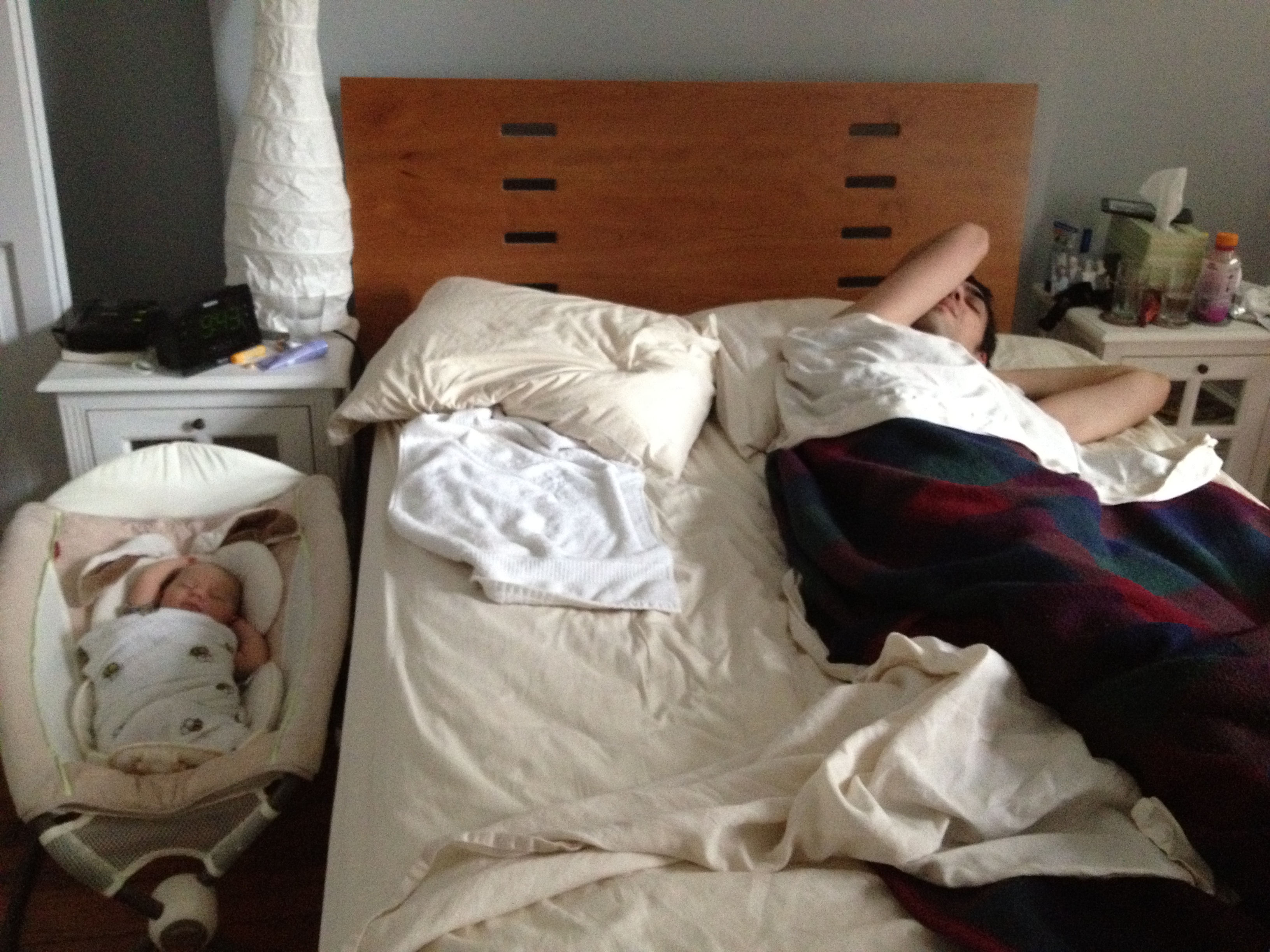
Like Daddy, like daughter
#2: Burping, pooping, and that moment just after burping or pooping
And, of course, like Jerry Seinfeld
#1: Breasts. (“Why would I be a leg man? I have legs.”)
How is it possible almost six weeks have passed and I haven’t chilled you to the bone with my How I Had My Baby story? Well, grab your warmest blanket and a mug of hot chocolate, kidlets, because here we go.
By Labor Day in early September, I was ready. My belly had gotten so big I felt like a house on legs, like in those Russian baba yaga stories. Since I am not the type to sit around knitting baby clothes, I had very little useful to do to occupy myself while I waited.
Thanks to an incredible series of classes with doula and midwife-assistant Shara Frederick and some serious book learnin’, both on the subject of childbirth itself and, more broadly, on the question of what kind of parent I didn’t want to be, I felt reasonably prepared for what was to come. (As part of that intelligence-gathering effort, I reviewed a couple of the Bad Mommy Memoirs I plowed through for Cheek Teeth: Are You My Mother? and Why Be Happy When You Can Be Normal?) I knew it would be difficult, especially for someone with so little experience dealing with enduring pain, but I also knew that putting it off wouldn’t make it any easier. So BRING IT ON, said I.
It was like shouting at the ocean. The baby had her own plan. In accordance with that plan, I found myself a week later still pregnant, still awkward and sore and quite tired of the ten-month gestation process. My “What to Expect” app had run out of even semi-useful tips and had started preparing me to “Start losing the baby weight!” First I need to lose the baby, I growled.
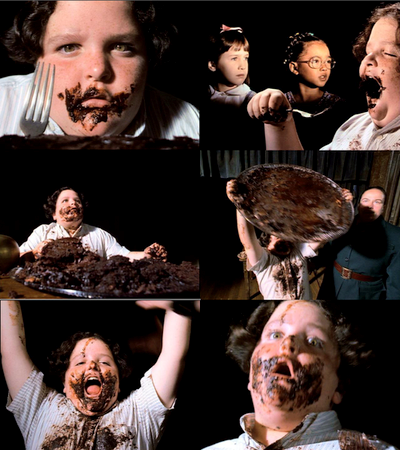
In an effort to lose it — or, more specifically, to loose it — on my due date, Monday, Sept 10, I got a prenatal massage from the fabulous folks at the Providence Day Spa on Atlantic Avenue and then ate a brownie the size of a cinder block.
I’m not sure which was more delicious.
By the time I was done, the contractions were both noticeable and regular, and the birth team stood ready: Mr. Ben with his catcher’s mitt out, Charrow in a rubber apron and gloves. We expected the early stages of labor to be rather slow-going, since it can often take at least half a day to make significant progress. But again, the baby had her own plans. After just a few hours, the contractions had gotten stronger and closer together enough that Mr. Ben called the midwives and the midwives said head to the birthing center.
CONTRACTIONS. MIDWIVES. BIRTHING CENTER. There’s been an infant cooking in my belly or dangling from my breasts for almost a year now and I still can’t believe this is my life. [/end note]
We gathered the ten bags of stuff we had put aside to bring to the hospital, called a car, and got to Methodist at about 8:00 PM. The pain was still manageable; everyone was excited; it seemed like perhaps the baby could propel herself out that very night and avoid the trauma of having her birthday forever synonymous with national tragedy.We all squeezed hands and waited for the midwife to come in.
There were five women in the midwife practice, and whoever happened to be on call when I went into labor would be my sherpa for this arduous, uncertain journey. Five women, and I really liked four of them. Any one of them would be fine; I wasn’t picky! Just, please, I told Mr. Ben, not Grumpy Gail — she had the bedside manner of a 12-year-old boy.
Naturally, the midwife on call was Grumpy Gail, giving my laboring body a choice to make. Should I keep barreling forward and aim to have the baby on September 10th, or throw the process into reverse and (probably) have the baby on September 11th with one of the others? The decision was made before I was even conscious of what it meant. My labor shuddered to a halt. Grumpy Gail sent us home with instructions to drink some wine, get some sleep, and come back in the morning.
Unfortunately, it turned out, the baby could only be put off for so long. About an hour after I tried to go to bed a contraction woke me with the force of a sledgehammer. It was followed in short order by another contraction, and another, both of which made the contractions of the evening — even the ones that sent me to the birth center — seem like cuddly embraces. There was no going back to sleep; no vineyard on earth had ever made wine strong enough to help me now. But what could we do? If we went back to the birthing center, we would have to put our trust in Grumpy Gail to see us through, and that was why we had left in the first place.
We decided to tough it out until dawn, when we figured the shift change would bring another midwife. What I didn’t fully grasp was that I was also electing to go through what would turn out to be a night of back labor at home without any kind of drugs. Back labor. At home. Drug free.
That, friends, is where our story really gets going. Stay tuned for Part Two!
Introducing Lara Calliope, born 9/11/12, 5 lbs 14 oz, 19″ long. She’s done some serious growing since then.
They call it “tummy time.” We call it “Pilates.” LC at 2.5 weeks.
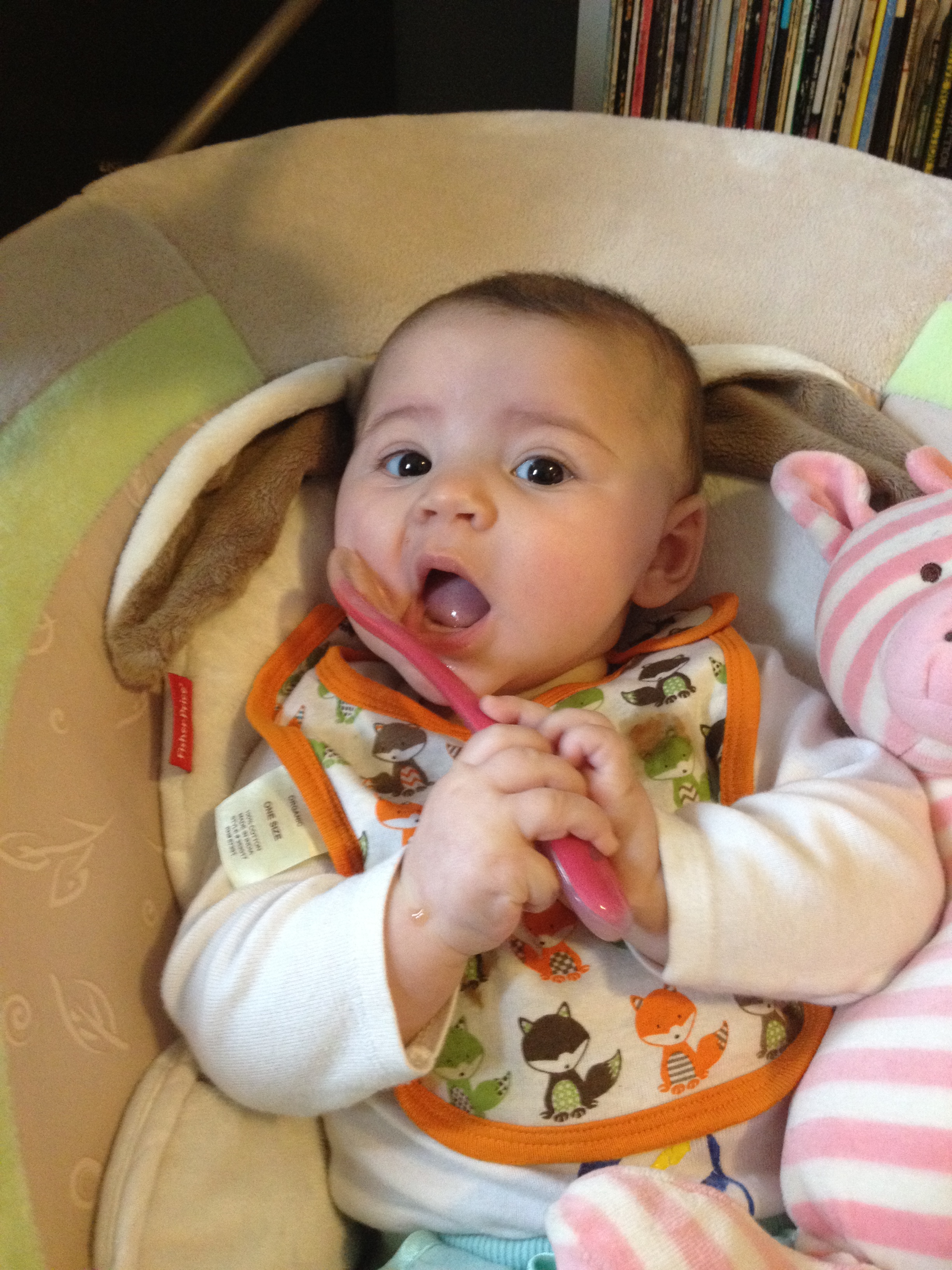
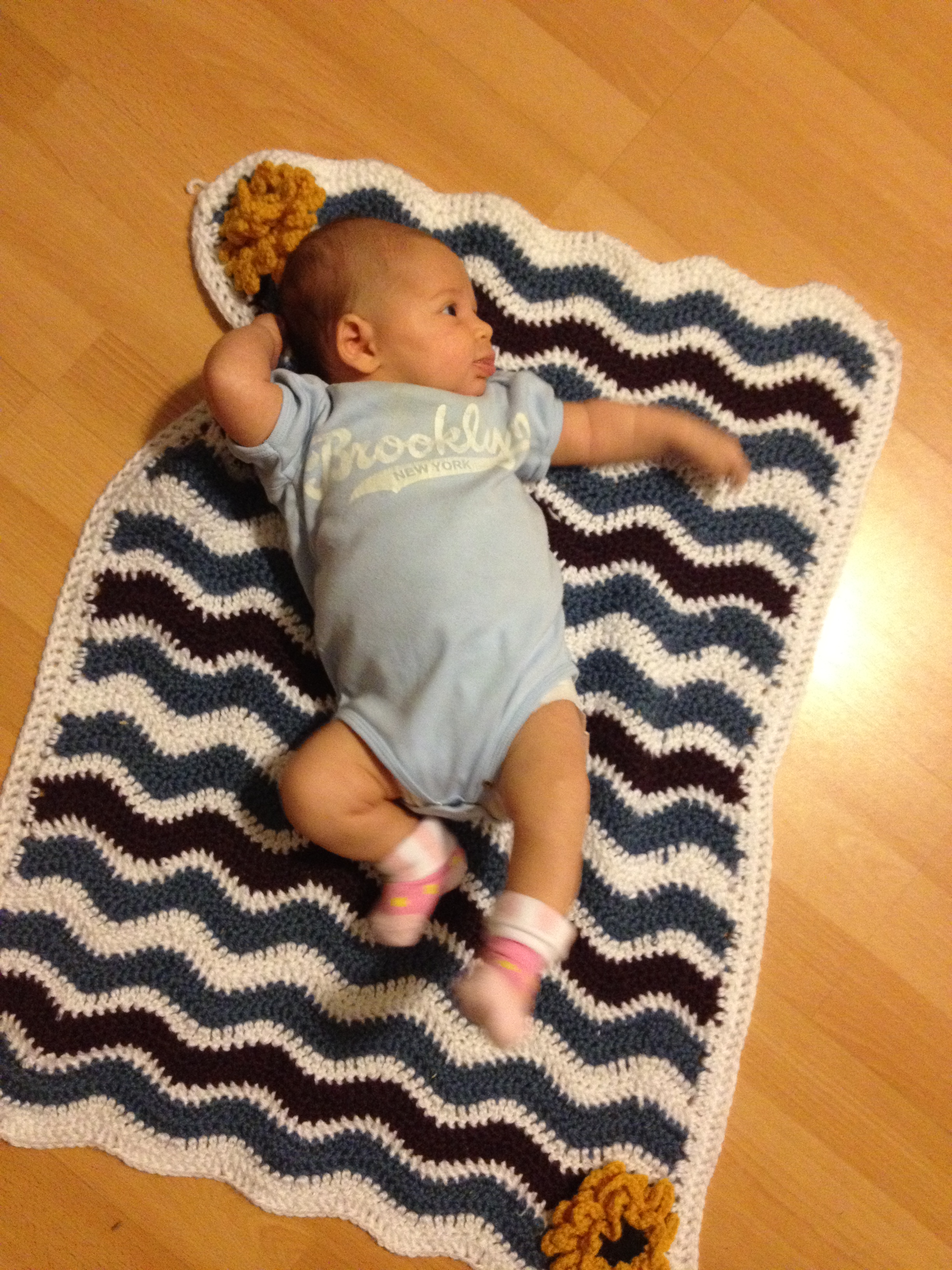
She is soft, warm, portable, sweet-smelling, and constantly hungry. We’ve had her now for almost three weeks, which means that we have passed the deadline to return her. Anyway, even if we had returned her, we wouldn’t have gotten our money back; we would only have been eligible for stork credit. (ba dum CHING!)
The blanket pictured above, by the way, was crocheted for us by our friend and Lara’s potential future mother-in-law, Tamar. That’s what she was doing while she was pregnant, besides also being a full-time medical resident at Johns Hopkins: making us both beautiful baby gear by hand. What was I doing? Tweeting, mostly, and trawling the Park Slope Parents list to get as much free and cheap swag as possible. But you know. We all have our priorities.
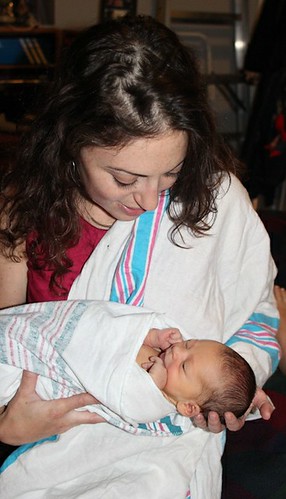
And now I’m a MOMMY. I know because that’s what they kept calling me in the hospital. (“How’s Mommy this morning?”) I never knew quite how to respond. (“Mommy’s cooch is a bit sore from all that labor, and can she maybe get some steak to put on her black eyes? She looks like she was in a bar fight.”) Luckily Mommy wasn’t in the hospital very long. She gave birth on September 11th at 12:00 noon and was discharged on September 12th at 4:30 PM. In between, of course, she had a very exciting adventure that involved lots of screaming and fluids and a midwife exhorting her to “roar like a lion” and the world splitting open and a new human being spilling out.
The new human being is tiny and perfect and more-or-less worth all the trouble of producing her. Her tall funny Southern friend Tara Leigh came to visit and marveled at just how tiny Lara is. “But of course,” she added quickly, “I’ve never met a Jewish baby before.”
A Jewish baby with, appropriately enough, Rebecca
Ben and I are overwhelmed and tired and happy and dizzy and all those things new parents are supposed to be. We’ve been very fortunate to have help from our own parents up until very recently. That allowed us to maintain a semblance of cleanliness & organization in our apartment. Now we’re on our own, which is daunting, but we still have our community, which has also been incredibly supportive & welcoming to our little bundle of needs.
We also have our health, which is not to be taken for granted. For example, and women do not talk about this enough, post-partum: it is super awesome not to be pregnant anymore. I can sleep on my stomach! My back doesn’t hurt! My feet are my own again! Of course my breasts have been appropriated and turned into a full-service, eat-in-and-take-out, open-24-hours Dairy Queen, but at least while I’m feeding the little piglet I can look down and admire my totally normal ankles.
My pregnancy is going fine. Anytime anyone asks, that’s what I tell them, and it’s the truth — comparatively, I’ve gotten off easy and I feel grateful. Yes, I was nauseous but not too drastically or for too long. Yes, I gained weight but my body didn’t morph into an entirely other formless, unrecognizable being, comme ca:
Largely I’ve been able to continue living my life with an acceptable level of inconveniences. I have been able to travel, I have been able to work. Of course, the inconveniences started to feel a bit like they’ve been piling on as I got closer to full term, including:
More uninvited interactions with strangers — in elevators, on the subway, at the coop.
Less breath for climbing stairs, let alone the gym. At this point, walking from my door to the door of the gym is all the exercise I can handle.
More waking up at dawn to feed the ravenous, insatiable creature that is [in] my belly.
More crying triggered by sudden, terrifying realizations, like that I don’t know how to change a diaper.
Less attention, time, money, and brain power available for anything besides Planning for Squee.
Once I blew by the milestone of Full Term (i.e., MORE THAN nine months pregnant), the pace of the piling on began to accelerate. One of my ankles decided to swell. Just one — but it had been my favorite! For a day or two, I looked like a pirate with a peg leg.
The swelling went down, and then the waddling started. For every step I take forward, I also move side-to-side, calling to mind a very poor imitation of Marilyn Monroe. (“Like Jell-O on springs!”) My boss, fondly, started calling me “Fatso.” It was definitely time to (maternity) leave.
Today, on my second day of baby-free maternity leave, I got my hair chopped off. (“Jo, your one beauty!”) Once I waddled all the way home, I realized I’d been wearing my dress backwards. Then I hoisted myself off the couch and had my third breakfast of the morning. This is just the way of things: the way pre-motherhood breaks you down, like the Marine Corps, so that you can be built back up again without your old, no-longer-useful standards of dignity. After all, soon you’ll be handling someone else’s poop on a daily basis; you have to get used to a certain amount of humiliation.
Squee, aren’t you eager to join the non-stop embarrassing hilarity that is the outside world? How can my womb compare? Come join the party, little one. We’re all waiting for you.